Bitcoin Fundamental Briefing, March 2025

STANDING ON A BACKSTAGE
This month cryptocurrencies and Bitcoin in particular were not as popular as in a previous few months. After elections’ hype of this subject, it stepped back in the shadow, while on the first stage we’ve got such topics as tariffs, mutual US-EU-UK piking, Ukraine, DOGE savings, some domestic political US scandals etc. Even two or even three different crypto summits in March was not able to shake up this topic and return it back to media headlines. People are more interested with stock market collapse and gold rally. BTC is considered just as asset that could be sold to get cash to fill the holes in margin on a stock market. Even topic of BTC national Reserves slowly has exhausted and faded. In general we wouldn’t say that this is unexpected. As we warned last time – until the US gets necessary legal base for Reserve, its appearing hardly possible.
MARKET OVERVIEW
Right in the beginning of the March Bitcoin hit its lowest level since November and was set for its biggest weekly fall in over two years, swept up in a sell-off in tech stocks at a time when a $1.5 billion hack and doubts about U.S. crypto policy has left industry sentiment fragile. The world’s largest cryptocurrency by market value dropped as much as 7% to $78,273.
A week before It has fallen 16%. The broader crypto market has lost nearly half a trillion dollars in the past week alone, according to Coingecko.
“Inflationary pressures, growth prospects are crumbling and Trump’s tariffs are not going away. And with Trump’s attention (on) anything except deregulating crypto, bitcoin traders are not happy,” said Matt Simpson, senior market analyst at City Index.
Investors fear the so-called exceptionalism of the U.S. economy might be fading and are nervous about U.S. President Donald Trump’s moves to impose tariffs which have stoked fears of higher global inflation and slower growth.
For the world’s largest cryptocurrency, the environment is very different from mid-January, when it approached $110,000 on optimism that the Trump administration would champion a strategic bitcoin fund and loosen regulation. But beyond a flurry of appointments of crypto-friendly officials when Trump took office, there has been little concrete news around that policy for investors.
The bitcoin price decline “shows that positive sentiments from a crypto-friendly administration and high-profile endorsements have run their course,” said Joshua Chu, Co-Chair of the Hong Kong Web3 Association. It’s clear bitcoin is a risk asset, not the inflation hedge or digital gold it’s often touted to be.”
Ether , the second-largest cryptocurrency by market value, was down 6% at $2,149.38, around its lowest since January 2024. Trump’s own “TRUMP” memecoin that he launched upon his inauguration has lost 50% in value since then, while his wife’s “MELANIA” token has lost 90%.
Investors have also been pulling money out of bitcoin exchange-traded funds. U.S.-listed bitcoin ETFs have seen outflows of $2.27 billion so far this week.
Bank of America analysts said in a note the fact that the average daily price of bitcoin had struggled to break above $97,000 since November was the first sign of the “bro bubble popping”.
Much of the hype around crypto in the last couple of years has stemmed from, typically, younger male influencers on social media and tech entrepreneurs that many nickname “crypto bros”.
Bybit, the world’s second-largest exchange after Binance, said hackers had stolen ether worth around $1.5 billion in what is thought to be the single largest crypto heist of all time.
“It’s a combination of macro forces. More tariffs, uncertainties around geopolitics and war, and the ByBit hack didn’t help confidence either,” said Reuben Conceicao, chief strategy officer at digital wallet firm Metasig.
Active D. Trump manipulations on cryptocurrency market also do not add confidence to investors, showing how weak and vulnerable it might be, destroying the trust to D. Trump promises. The manipulation has happened twice or even three times. First one on signing of BTC Reserve act, but later it has become clear that it contains nothing positive or new for BTC industry. Traders become angry suggesting that D. Trump did this just to let his people out of some crypto assets.

Next manipulation has followed just a few days ago when he pumped his $Trump coin:

If Trump were using social media to manipulate stocks to help his family and friends make millions, it would be illegal and he could be impeached. But with cryptocurrency, it’s perfectly legal. That’s probably why he’s made the about-face and become a “crypto president.”
As you understand, if the President of the US lets himself to do such things on the market that supposed to be as a very important for the US… it could mean that either he doesn’t treat it seriously or his promises cost nothing. Both conclusions destroy investors’ confidence and any wish to invest there.
Barely six weeks after Trump was inaugurated,bitcoin has sunk into a bear market, drained by a sell-off in global stocks. Just weeks after hitting a six-figure all-time high, the largest cryptocurrency is now trading at around $80,000, down nearly a quarter from its January peak.
A wave of investors that entered the market chasing bitcoin’s rally past $100,000, especially those using borrowed money, are feeling the pinch from its decline. At least 20 million new bitcoin addresses – about 1.5% of all bitcoin addresses in existence – have been created in the past three months, according to crypto data and analytics firm Glassnode.
The ratio between the prices at which new bitcoin is being bought and sold, known as the spent output profit ratio, has meanwhile dipped to 0.95, its lowest level in over a year and negative for the first time since October, according to estimates from crypto exchange Bitfinex.
“This suggests that recent buyers are locking in significant losses, reinforcing the exceptionally challenging conditions for newer investors,” analysts at Bitfinex said.
“I was surprised to see bitcoin at $80,000 and it looks like the bloodletting hasn’t ended yet,” said Kevin Dede, analyst at investment bank H.C. Wainwright.

Meanwhile, investment products tracking digital assets saw outflows for the fourth straight week, according to CoinShares data. Total assets under management in these products have dipped around $4.75 billion to $142 billion. That’s the lowest since mid-November 2024 after the U.S. election.
U.S. spot bitcoin ETFs saw outflows of around $1.1 billion in outflows on February 25, the biggest daily outflow since their launch in January last year, according to J.P.Morgan.
While past sell-offs in crypto markets are often followed by some amount of calm as the market finds its footing, bitcoin may be at the mercy of broader markets for the time being.
The implied or future bitcoin volatility priced into derivatives has spiked to 69% in the last 24 hours, while the second-largest token ether’s implied volatility has increased from 65% to 90% since Monday, meaning investors expect more choppiness ahead, according to Amberdata.
“The last two weeks have 100% been driven by the equity market tantrum,” said Jeff Dorman, chief investment officer at asset manager Arca in a note. “This likely plays out similar to what we saw in late 2018, which was nothing more than a short-term hiccup on the way to further highs.”
Now BTC price is recovered slightly around $87,000 mark amid easing concerns about the introduction of US import duties. The capitalization of the crypto market returned to $2.96 trillion
Bloomberg, citing its own sources, reported on the transition of the administration of US President Donald Trump to a more “targeted” approach when introducing the announced trade duties. The head of state is allegedly ready to abandon fixed rates in relation to a wide number of countries and associations. It is expected that the policy will be more flexible, with an emphasis on “mutual” offers and the use of non-tariff barriers.
“Cryptocurrency markets are rising as investors respond positively to Trump’s more accommodative stance on tariffs that will take effect on April 2, as well as the Fed‘s focus on long — term inflation trends,” commented Vincent Liu, investment director at Kronos Research for The Block.
A number of analysts from Wall Street companies allowed bitcoin to move to growth in the second month of spring. However, some have limited the prospect of an uptrend to the $90,000 resistance level. According to them, the cryptocurrency is unlikely to overcome the mark due to the lack of significant catalysts for a reversal.
CryptoQuant founder and CEO Ki Yong Joo announced the end of the bitcoin bull market in March. According to his forecast, in the next six months or a year, quotes will decline or be in a sideways trend.
Later, answering the main counterarguments to his position, the analyst denied the expected arrival of retail investors, which can act as a growth driver. He noted that most “physicists” have already invested in digital gold through ETFs, and this is not recorded by on-chain data.
On recent Fed’s meeting J. Powell announced turn from QT to QE, reducing of securities sell-off for 20 Bln monthly. This let to many traders start speaking about BTC upside reversal. Indeed that it is positive sign for BTC, but we should consider it in complex. Fed also has increased inflationary expectations and cut GDP forecast, giving the clear hint on stagflation. This is most negative combination for stock market. And any downside trend there will cancel or, at least postpone, bullish turn on BTC market. Besides extreme uncertainty due D. Trump foreign policy cuts BTC chances to get inflows because investors remain focused on safe haven assets.
BACK TO STRATEGIC RESERVE
In fact, D. Trump has re-fresh this topic once BTC starts dropping like a stone. Immediately some summits have happened. You should remember the one from 6th of March, but there was another one – 11th of March. But what achievements have been reached? I would say – nothing.
Senator Cynthia Lummis, a pro-cryptocurrency advocate, acknowledged that there is not enough support for the project in Congress. At Bitcoin Investor Day in New York, she noted that even Republicans are skeptical — House Banking Committee Chairman Tim Scott has suggested shelving the initiative, citing the country’s lack of readiness. The idea of BTC Strategic Reserve is still unlikely.
Seeing that BTC is falling like a stone into the hell, D. Trump immediately has signed the act. But what the major points of this act? Market was totally disappointed, to say the least.
The reserve will be filled with bitcoins owned by the federal government that have been seized through criminal or civil asset forfeiture proceedings, meaning it will not cost taxpayers a dime.
The Secretaries of the Treasury and Commerce are authorized to develop budget-neutral strategies for acquiring additional bitcoin, provided that these strategies do not impose additional costs on U.S. taxpayers.
the Executive Order creates a U.S. digital asset reserve consisting of digital assets other than Bitcoin seized in criminal or civil proceedings. The Government will not acquire additional assets for the Reserve beyond those acquired through the confiscation process.
Other words speaking, when you have $300 Bln budget deficit, it is difficult to find the way how to buy more BTC without using budget money. So, it seems that government counts on BTC confiscations to increase Reserve size.
This kind of act shows that it was not prepared for signing, or planned to be signed. It was done mostly by circumstances and gut feeling, that something needs to do. Because it is no sense at all with this kind of BTC Reserve act.
Let’s see the progress in legislation activity among the states. BTC reserve bills are currently under consideration in 18 US states. Another 33 states are considering creating such reserves. But only Utah has successfully advanced a bill in the other chamber. 
Let me remind you that recently a lot of attention has been paid to stablecoins as a new basis for the financial system. Moreover, these same stablecoins will also have to solve the problem of demand for government debt. It is very interesting to see that the person at the helm of the largest stablecoin thinks the opposite.
Ardoino remarked that he envisions a financial reset that would bring fiat currencies to their knees, rendering USDT useless. In this dire situation, bitcoin will become the only alternative to avoid devaluation and hyperinflation.
I expect a financial reset, where all national currencies will collapse and experience hyperinflation. Consequently, USDT will be completely useless, and at that point, I believe the world will only use Bitcoin. Still, I believe a product -USDT- should exist as long as there is a need,” Ardoino concluded.
Meantime, Newmarket Capital CEO Andrew Hohns has proposed including Bitcoin in government bonds, which could then be used to reduce government debt and replenish crypto reserves.
Hohns proposed that the US government issue $2 trillion in Bitcoin Bonds, and then use 90% of the funds to pay off the country’s debt and 10% to buy the flagship cryptocurrency. This means that for every $100, about $10 would be BTC.
If $2 trillion were to be issued at once, that would mean $200 billion worth of Bitcoin could be purchased at $90,000 per coin. That’s $2.22 million BTC.
It would also allow the government to obtain just over $50.8 trillion in bitcoin, which is the expected size of the federal debt in 2045. In other words, with the proposed plan, we will be able to reduce the federal debt, Hohns said.
He said the approach would also save the government $554 billion in 10-year interest rates. That’s because the interest rate on bitcoin bonds would be 1% per year, compared to 4.5% on U.S. Treasuries.
In addition, Bit Bonds can attract not only American but also foreign investors. Depending on the dynamics of Bitcoin, investors’ profits can range from 7% to 17% per annum without paying taxes.

So, we will get both a bitcoin reserve and a bonus in the form of securitization. The US is creating a global debt market parallel to Treasuries on Bitcoin. In order to smoothly jump off the old pyramid onto the new one… to earn money ourselves… to maintain the purchasing power of pension plans, not to create an outflow of capital from the USA and to remain the hegemon… and 99% of investors in the world refuse to understand this because it sharply cuts all the foundations of the traditional financial system…
VanEck’s latest research suggests that a US BTC strategic reserve of 1 million BTC by 2029 could reduce the national debt by around $21 trillion by 2049.
Okay, from political surrealism to serious economic issues. Keep it simple, their forecast says the following – over the next 25 years, the price of bitcoin will grow from about $100,000 to $21 million. That is, 210 times. About the national debt – it’s all fluff.

What does this tell us? That the average annual return of bitcoin over the next 25 years will be 23.8%. Is that a lot or a little? Over the past 12 years, Apple shares have shown an average annual return of 25.7%. Yes, having entered the bubble stage, but nevertheless, the return they promise for bitcoin is lower than Apple’s. Not that it’s a bad asset, but the return, taking into account the risks, could have been promised higher.
Once again – they point of 2045-2049 and yields around 17-25%.
And another one interesting document. But this is more about the source to finance the purchasing (should cost no dime to taxpayers, right?) .A senior White House official, Bo Hines, has suggested using the profits from the country’s gold reserves to increase Bitcoin reserves. In his opinion, this could be a budget-neutral way to expand the US digital assets.

Bo Hines refers to the “Bitcoin Act of 2025” proposed by Senator Cynthia Loomis. This law proposes that the US purchase 1 million BTC over five years, which would amount to about 5% of the total supply of the coin. The financing is planned through the sale of Federal Reserve certificates.
Alternative point of view suggests more global role for Bitcoin and considers Debt problems solution only as a by-product result. The major task is to replace stock market as the major source of wealth for wide society of investors:
The goal of a long-term bitcoin pump by creating a strategic reserve is not to solve the problem of the national debt. The goal is to inflate the (global) market of a new financial instrument by trillions and tens of trillions of dollars and sharply increase that same average expected future income according to Friedman, so that consumer and corporate demand at least does not decrease, not to mention that it is desirable for it to grow.
it is necessary to replace the exhausted stock market as an asset class that creates income for investors. At least for the period until real economic measures solve the problem.
Need to justify the price? No problem – halvings plus increasing mining capacities, which allow increasing the cost price in direct proportion to the price growth, so that no one can say that the price is unjustified. Have you seen the cost price of mining? Everything is justified.
if it is also recognized as a means of payment, then everything becomes even better – the world’s non-credit money supply is growing. In fact, this is the replacement of monetary incentives in fiat currencies. That is, holders simply have more money, which should still allow the traditional system to solve problems and deflate debt bubbles.
The dollar is the world’s reserve currency because it is backed by an unrivaled financial infrastructure [simplified]. The United States does not need dollar reserves to back the value of dollars, just as Apple does not need Apple stock reserves to back the value of its stock. It is backed by company performance.
But printing unsecured dollars to buy assets that do not add goods and services to the economy (BTC and others) is a direct threat to the notorious reserve status. Perhaps this is the very purpose of the special operation: it creates the preconditions for an accelerated rejection of the burdensome status for the US.
To close for now the topic of strategic reserve, let’s set the bottom line. First is – reserve is creating for big target. Either resolving of the debt problem, or replacing stock market as the source of public wealth to keep consumption and doesn’t let economy collapse.
It might be done in different ways and one of them is securitization – emission of bonds that backed by BTC’s.
The only problem that I see here is a BTC price. Everybody writes “price… price… it will boost BTC price etc.”. But what price? BTC will be costed in some other currency, dollars? But the boost might be just the indicator of inflation and probably will be. But in this case for foreign holders of the US debt it will be the same – whether the US just print dollars and payout the debt by devalued currency or do it via BTC later. What’s the sense?
It seems that the US doesn’t care about foreign debt holders but care only about domestic wealth. If they just print $30 Trln – it will be immediate devaluation of the wealth in the US. This seems to be a reason for me, why they intend to do this via BTC.
Another problem is the price boost. The boost has to be in real value, but it is possible only by real capital inflows outside so, that the BTC price growing at the same pace against gold, commodities etc. So that it has the real price growth. This is the weakest point in this strategy.
You have to assure investors somehow to not invest in classic commodity and other safe haven markets (Swiss bonds or something else) but stay focused on BTC. Currently I’m skeptic on this chance, taking in consideration the huge BTC volatility and tricks that D. Trump does there.
All in all we have to understand the simple thing. The wealth is not coming just from nowhere, from the emptiness. It can’t be created artificially by just twisting and turning chips around from one pocket to another. It means that all this stuff that the US is inventing with BTC will be the big scam and rob of the century. It reminds me the idea of philosopher’s stone to turn garbage into real gold. I have no objection to trade BTC here and there, even keep it in portfolio, but I prefer to stay away from it when the topic of long term investment and wealth preservation is touched.
NEW BTC FORECASTS
Just last week there is a big change has happened in forecasts of BTC price. The reason is the recent Fed meeting and its announcement of QT contraction. Following this logic analysts suggest that level of liquidity will increase and part of it will go to BTC market as well.
Although there is indeed the logic exist, we suggest that it is not as simple. Just because we have to take in consideration other data. Those who read our FX and Gold regular reports know very well in what conditions the US economy now stands. Even speaking about recent Fed statement, we should recall that besides of QT, the Fed has cut GDP forecast and raised inflationary expectations. Both changes together give a hint on possible stagflation stage.
By taking a look at overall sentiment in the US economy it is dropping with the fastest tempo. Very weak consumption indicator in the PCE [US household sentiment] report – the only time it was worse was in February 2021. For the markets, this is even more frightening than the stability of core inflation [which is not going anywhere].

Based on the PCE figures and the $50 billion lost due to the growth of the trade deficit, the GDP data will not be stellar, even despite the fact that the budget deficit in January 2025 compared to last year added an extra $100 billion. Although for now the GDP should be in the positive.
The nearest point when it will be determined whether everything will remain as it is or will definitely go downhill is March with the next ceiling of the state debt and squabbles over state spending. It will definitely not be boring.
Atlanta Fed forecast model projects sharp GDP decline in Q1:

The Conference Board’s consumer confidence index fell 7.2 points to 92.9, its lowest since Covid. There is a big discrepancy, though – the current situation assessment index is worsening, but not that much, while the expectations index has collapsed to 2013 levels of 65.2, below the critical threshold of 80, indicating the risk of a recession.

Americans have found themselves in an environment of uncertainty that is unfamiliar to them, so for now it is more of a fear; inflation expectations for the next year, according to CB, have grown from 5.8% to 6.2%. The main problems, according to the Americans surveyed, are inflation and tariffs.
In two days we get fresh PCE numbers and also markets will be watching for 2nd of April and what tariffs will be imposed. Meantime, households exposure on the US stock market hits all time highs, reaching 51%. Any minor signs of recession could trigger panic sell-off and BTC will fall among the first. So, for now we suggest that it is too early for strong upside revisions of BTC levels.
Still, let’s take a look at what other traders think:
RACOON FINANCE:
Considering that we expect the S&P500 to grow to 5900 (closer to May), Bitcoin is capable of rising to 98k in the coming weeks. Where I will make a decision on reducing part of the position to cash.
The market has been cleaned out. From March 12 to March 25, shorts were wiped out by only $1.14B, and longs by $1.26B. For comparison, in the previous window (from February 24 to March 12), longs were wiped out by $7.2B, and shorts by as much as $2.8B. So the difference is obvious: everyone has become much more careful with leverage.
And if so, then the price will go in the direction of least resistance. The probability of reaching 100k is now, in our opinion, greater than falling below 80k.
The U.S. Bureau of Economic Analysis (BEA) will release its latest PCE report, which measures inflation in the prices of consumer goods and services in the U.S., on March 28.
Given the surveys of retailers and other consumers that have reflected negative sentiment, the likelihood of a decline in the indicator of basic personal consumption expenditure is very high. In this case, Bitcoin could quickly recoup all the losses of the past weeks.
It will also be important in the coming days what tariffs the US will ultimately impose on other countries on April 2. According to unconfirmed information from the media, relaxations and/or postponements are expected for additional consultations. Time is now working for Bitcoin
JAYPOW delivered, QT basically over Apr 1. The next thing we need to get bulled up for realz is either SLR exemption and or a restart of QE. Was BTC $77k the bottom, prob. But stonks prob have more pain left to fully convert Jay to team Trump so stay nimble and cashed up.
QCP In the current environment, QCP Capital prefers gold and recommends focusing on yield strategies with protection of the principal amount of debt in order to avoid a long downturn.
It’s been a month since the S&P 500 hit a new high, but the mood has soured. Market exuberance is gone, and risk assets remain under pressure. How much longer can this last?
The current pullback of bitcoin will last until March or April, before an attempt is made to rally to previous highs. This is the conclusion reached in Matrixport. In the current environment, funding rates and underlying spreads are too low to justify holding positions and opening new ones, experts said.
According to Ryan Lee, chief analyst at Bitget Research, in an interview with Cointelegraph, macroeconomic problems can lead to the development of a correction to $76,000-$78,000.
The uptrend of the first cryptocurrency has come to an end, and in the next 6-12 months, quotes will decline or be in a sideways trend.
This is the conclusion reached by CryptoQuant CEO Ki Yong Joo.
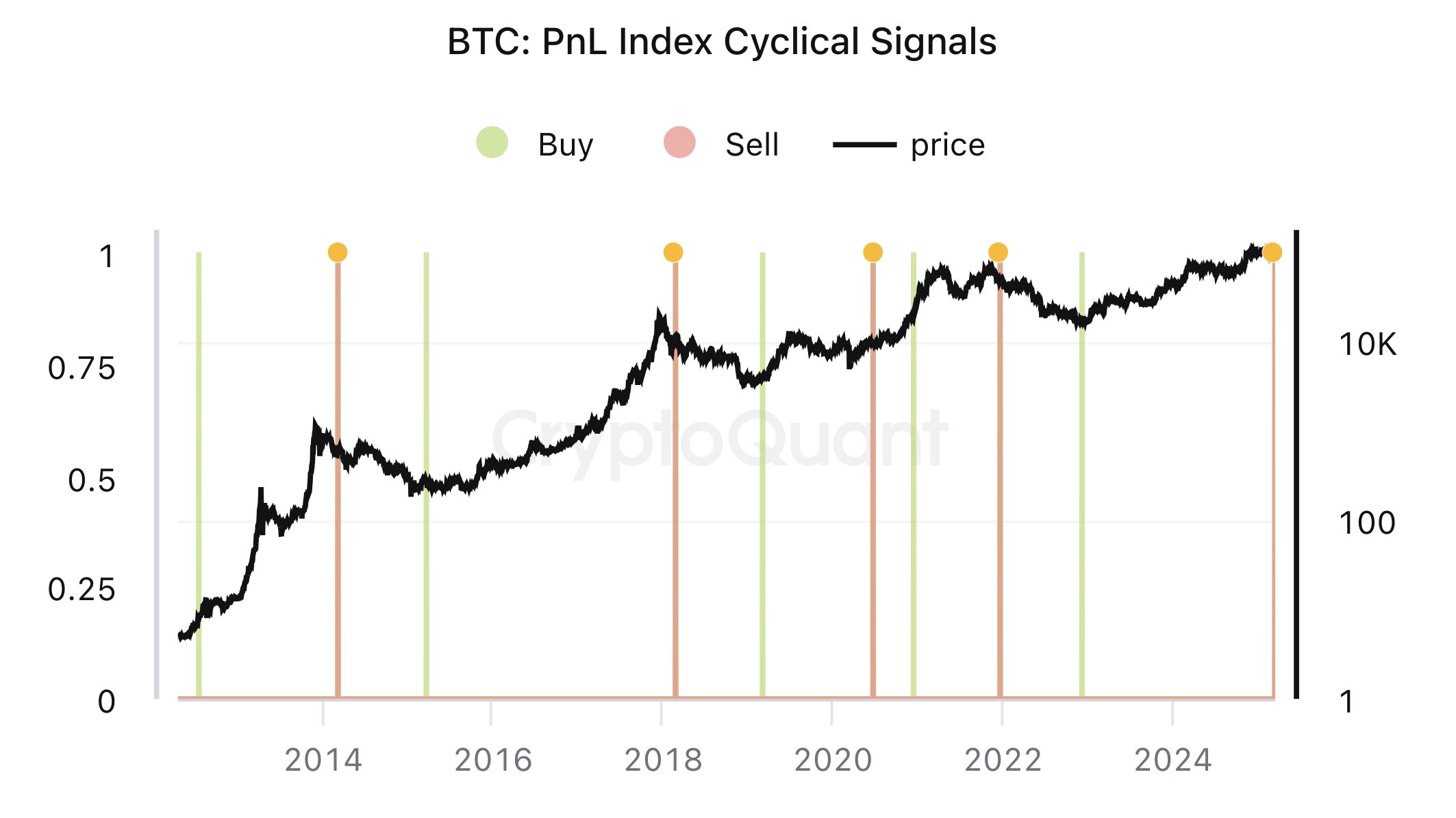
Every on-chain metric signals a bear market. With fresh liquidity drying up, new whales are selling Bitcoin at lower prices.
This alert applies PCA to on-chain indicators like MVRV, SOPR, and NUPL to compute a 365-day moving average. This signal identifies inflection points where the trend of the 1-year moving average changes.

СONCLUSION:
So the most positive forecasts for nearest 3-4 weeks suggest price return back to the top and contraction of retracement depth. For now it seems so, as BTC has shown more extended bounce to ~90K area. At the same time, BTC now stands highly vulnerable to external events, tariffs, data and stock market performance in particular. We do not expect drastic improvements in the US economy, which means that BTC most probably remains under pressure.
That’s what really important for now. The breakthrough around BTC reserve might happen not earlier than on summer when special BTC government committee will prepare the first report on this subject. Until we get big fundamental and legislative shifts the wide consolidation seems more probable as it is suggested by CryptoQuant CEO.
Author Profile

Sive Morten
By day Sive Morten works for the large European bank. In that roll he evaluates the markets including currencies market managing bank risks and evaluating the bank portfolio.
At the Forex Peace Army, he is known as an author of Forex Military School, which quite unique free forex trading course. We do not know of any other free forex trading education covering such a broad spectrum of forex market concepts in such details while keeping it easy to understand and practically use.
As if that wasn't enough, he is the part of the Shoulders of Giants Program. He shares with his fellow traders at FPA his view and forcast of the Gold Market, Currency Market, and Crypto Market in form of weekly analytics and daily video updates.
* Complete Forex Trading Course by Sive Morten >>
* Sive Morten Forex , Gold , and Crypto Analysis >>
At the Forex Peace Army, he is known as an author of Forex Military School, which quite unique free forex trading course. We do not know of any other free forex trading education covering such a broad spectrum of forex market concepts in such details while keeping it easy to understand and practically use.
As if that wasn't enough, he is the part of the Shoulders of Giants Program. He shares with his fellow traders at FPA his view and forcast of the Gold Market, Currency Market, and Crypto Market in form of weekly analytics and daily video updates.
* Complete Forex Trading Course by Sive Morten >>
* Sive Morten Forex , Gold , and Crypto Analysis >>
Info
238 Views 0 CommentsComments
Table of Contents
Recent
ePlanet Brokers Expands Transparency Efforts With New H1 2026 Operational Disclosures PrimeXBT Rewards Center Explained: How to Earn Cashback, Trading Bonuses and VIP Benefits Bitcoin Fundamental Briefing, August 2026 How to start forex trading How to choose the best forex broker? XAUUSD vs EURUSD: What Actually Changes When You Trade Gold Can You Buy Real US Shares With USDT? Ownership, Dividends and Shareholder Rights Explained Bitcoin Fundamental Briefing, July 2026
Popular
The Psychology of Forex Trading Forex Trading in the United States How to Combine Different Types of Forex Analysis Forex Peace Army | Forex Reviews by Traders | Evolution and Future Forex Peace Army Executive Team Forex Sentiment Analysis How to add or remove horizontal and vertical lines in MetaTarder 4 How to select a forex broker
Popular Discussions
Gold Daily Video, September 17, 2026
Gold Daily Video, September 18, 2026
EUR/USD Daily Video, September 17, 2026
BTC/USD Daily Video, September 17, 2026
EUR/USD Daily Video, September 18, 2026
Exness withdraw problem
PUBLIC COMPLAINT AGAINST XM GLOBAL: -€22,149.84 IN SUSPICIOUS LOSSES, GHOST STOP LOSSES AND ABERRANT MARGIN LOGS
Octa – Account under internal review, withdrawal declined, leverage reduced from 1:2000 to 1:200 (Client since 2017)