Bitcoin Fundamental Briefing, June 2025

WICKED GAME
…indeed. This month market is hungry for real big, breakthrough news, some epic shifts on BTC. Everybody were waiting for adoption of a new stablecoins bill, So its passed but whats next? At the same time, this month was so representative in terms of manipulations. It clearly has become a hostage of D. Trump geopolitical games and in fact now stands as a pocket market. What’s the investors confidence now, whats the degree of trust, if the 1st man of the country falls down to just full his pockets, using geopolitics and manipulating domestic markets…. Every more or less solid action on BTC this month was triggered by Donny’s tweets.
MARKET OVERVIEW
Bitcoin slid below $100,000 for the first time since May and Ether sank sharply after President Donald Trump said US bombers attacked Iran’s three main nuclear sites, triggering risk aversion in weekend trading in digital-asset markets.
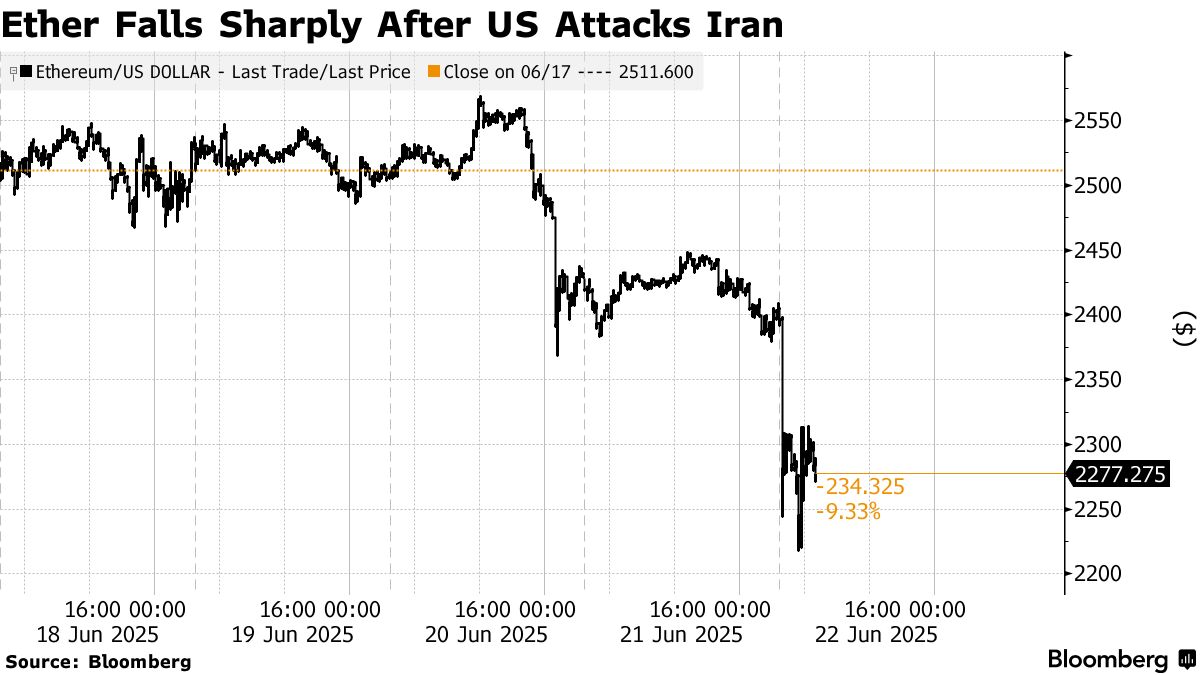
The latest losses come after Trump said the Iranian sites of Fordow, Natanz, and Isfahan were struck in the operation, specifically describing a “payload of BOMBS” dropped on Fordow, a key location of uranium enrichment that has raised international concern that Iran was preparing to create a nuclear weapon.
Total liquidation of crypto bets over the last 24 hours was more than $1 billion, with about $915 million and $109 million in long and short positions closed respectively, according to data compiled by Coinglass.
“Markets are nervously eying ongoing geopolitical developments,” said Caroline Mauron, co-founder of Orbit Markets, a provider of liquidity for crypto derivatives. The focus of markets will be largely on oil when traditional markets reopen, she said.
“The overhang of whether the US would strike Iran caused a sell-off through the week and into the weekend,” said Cosmo Jiang, general partner at Pantera Capital Management.
The number of transactions settled on the Bitcoin network has dipped this year to around 500,000 a day, from between 600,000 to 700,000 in 2024, the report said. At the same time, monetary amounts settled have remained strong, with more than $7 billion worth of the cryptocurrency being transferred every day this year.
“Obviously there’s the institutional factor where as more and more institutions are coming in, we’re seeing larger sizes being traded and a lot of appetite from all types of institutions from family offices to asset managers to pension funds to sovereign wealth fund,” said George Mandres, senior volatility and derivatives trader at XBTO Trading LLC. “In general, a lot of new retail traders will probably just buy the ETF as opposed to buying Bitcoin on exchanges.”
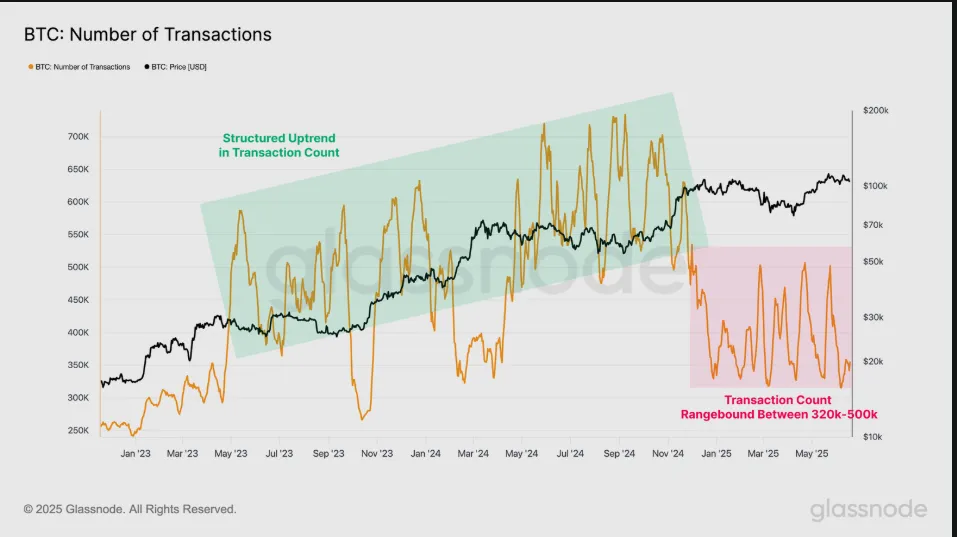
So while the number of transactions have reduced, the amounts of each completed trade on the network have increased, suggesting that the fewer active traders are moving larger amounts when they make transactions.
“When we look in terms of the on-chain data on the Bitcoin blockchain as opposed to in financial markets, so we we’re seeing more use of Bitcoin as a store of value rather than a medium of exchange,” said Zach Pandl, head of research at Grayscale Investments. “And if Bitcoin is going to be digital gold in the longer run, this may actually continue.”
Still Assets held in crypto funds hit a record high in May as easing trade tensions lifted risk appetite and some investors used the digital currencies to hedge against market volatility and diversify from their U.S. holdings.
Morningstar data on 294 crypto funds shows they attracted $7.05 billion in net inflows last month, the highest since December, bringing total assets under management to a record $167 billion.

Nic Puckrin, analyst and founder of Coin Bureau, said one of the main drivers of bitcoin’s rise is a loss of faith in the U.S. investment story.
“The greenback is projected to keep plummeting, bond yields are rising, there’s uncertainty about the equity markets. But bitcoin seems to be holding strong.”
International markets appear to have convinced themselves that the latest conflagration in the Middle East can be looked through as easily as all the region’s other flare-ups of the last decade. Gold prices fell, Treasury yields rose, and equity volatility dropped Monday as Israel and Iran continue to pound each other with bombs and missiles. Most startlingly, stocks rebounded; relative to long bonds, they are their strongest since the day after President Donald Trump’s inaugural.
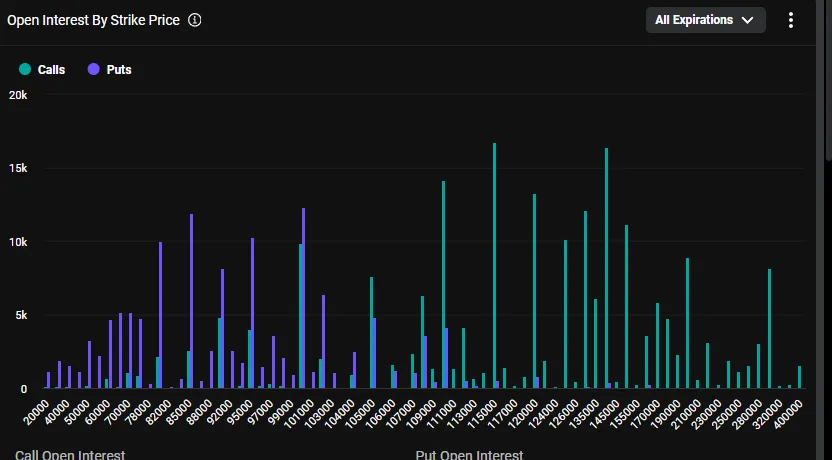
Bitcoin options show traders are hedging against a price pullback to the $100,000 price level with geopolitical and economic uncertainty lingering over global financial markets.
The put-to-call volume ratio on the crypto derivatives exchange Deribit surged to 2.17 over the past 24 hours, reflecting a strong tilt toward protective bets.
The caution comes as Federal Reserve officials left interest rates unchanged and continued to predict two rate cuts in 2025, citing high uncertainty over the economic outlook that has diminished. Fed Chair Jerome Powell said he expects a meaningful amount of inflation in coming months.
STABLECOIN “GENIUS ACT” BILL
The passage of stablecoin legislation in the US Senate marks a huge leap forward for the potential mainstreaming of cryptocurrencies that track the US dollar one-to-one. Yet there are still big problems to solve before many businesses can capitalize on the opportunities that are arising. Now, stablecoins are taking the leap from their original use as crypto-market poker chips to common mediums of exchange, offering merchants and consumers cheaper and more efficient payments systems.
If signed into law, the stablecoin bill would require tokens to be backed by liquid assets – such as U.S. dollars and short-term Treasury bills – and for issuers to publicly disclose the composition of their reserves on a monthly basis.
Stablecoins must always be exchangeable at par (1:1 to the dollar), but cannot earn interest like deposits or money market funds.
“As with any new form of value, widespread adoption necessitates regulatory clarity, consistent legal frameworks across jurisdictions and – importantly – interoperability with existing infrastructure and assets,” said Tom Zscach, chief innovation officer at Swift, the global bank-messaging cooperative. “Without this last point, new assets just risk creating additional fragmentation in an already complex financial ecosystem.”
For merchants and other businesses, the advantages of using the tokens could be significant: lower transaction costs, faster payments and 24/7 availability.
It all could lead to an explosion of growth in the sector. The world’s supply of stablecoins could swell to as high as $3.7 trillion by 2030 if growing integration of digital assets into traditional finance and favorable macroeconomic conditions continue, Citigroup Inc. analysts said in an April report.
While the sector has already rapidly grown in popularity, stablecoins are still largely used for transactions related to the cryptocurrency market rather than business payments. The total volume of all stablecoin transactions was nearly $4 trillion in February, according to data compiled by Allium Labs and Visa.

Still, stablecoins remain cumbersome for very large payments due to relatively low liquidity compared with the vast volumes handled by global banks each day. JPMorgan Chase & Co. alone processes around $10 trillion in daily transactions.
“Where it gets clunky is in the hundred of millions of dollars,” said Chris Harmse, co-founder of stablecoin payments company BVNK. “If you are moving interbank-sized flows it will get clunky.” This is likely to change as stablecoins gain further acceptance by existing payment processors, he added.
Today, compliance with taxes and local rules are taking priority for businesses over speed or cost efficiency, according to Gabriele Zuliani, chief revenue officer for crypto exchange Bitso Inc.’s business division.
“Stablecoins still bring a number of structural disadvantages,” Heiko Nix, Siemens global head of cash management and payments, said in an interview. These include currency conversion steps and FX risk, especially when stablecoins are US dollar-pegged and used in a euro environment, Nix said.
Tokenized commercial bank money offers all technical benefits — 24/7 availability, programmability, atomic settlement — while retaining the legal and accounting features of conventional cash,” Nix said. “It integrates seamlessly into our systems without added complexity,” he added.
Risk emanating from cryptoassets could soon become a serious threat to the financial system, according to outgoing Financial Stability Board Chair Klaas Knot.
“At the FSB, we have long maintained that crypto does not yet pose a systemic risk, but recent developments suggest we may be approaching a tipping point,” he said in Madrid on Thursday.
He highlighted that stablecoin issuers “now hold substantial amounts of US Treasuries — this is a segment we must monitor closely.”
In its latest Financial Stability Review in May, the ECB also flagged risks from crypto assets like stablecoins, especially given rising valuations and closer interconnections between the digital-asset ecosystem and traditional finance.
Charles Schwab CEO Rick Wurster told Reuters earlier this month that the traffic lights from financial regulators were flashing “pretty green” for large firms to grow in crypto. The signals have reinforced Schwab’s plans to offer spot crypto trading within a year, he said.
It is unclear if the various crypto treasury strategies will ultimately be successful, particularly if firms are buying in now as prices flirt with record highs in a sector that is no stranger to volatility.
Charles Schwab, in a report last month, noted that if a company has significant crypto holdings that suddenly collapse in value, the firm could experience a liquidity crisis. Standard Chartered estimated that if bitcoin were to fall back below $90,000 it would put half of companies’ bitcoin treasuries underwater.
France’s Societe Generale said on Tuesday it plans to launch a publicly tradable, dollar-backed stablecoin through its digital asset subsidiary, making it the first major bank to enter the growing market of dollar-pegged cryptocurrencies.
The new digital currency, named “USD CoinVertible”, will be issued on both the Ethereum and Solana blockchains, with public trading expected to start in July, SocGen’s crypto arm SG-FORGE said in a statement.
The largest US corporations are considering the possibility of issuing and using stablecoins to break out of the traditional financial system, speed up payments and save a lot of money.
The largest US bank JPMorgan will start accepting BlackRock’s Bitcoin ETF as collateral for loans to its clients from its trading and wealth management divisions, Bloomberg reports, citing informed sources. JPMorgan will also include crypto ETFs in its calculation of liquid assets, meaning cryptocurrency ETFs will be treated like other financial instruments when determining the amount a client can borrow against their assets, the agency said.
FORECASTS
Bitcoin could keep rising at gold’s expense in the second half of the year, boosted by corporate buying and growing support from U.S. states, according to JPMorgan analysts.
The analysts say the debasement trade has turned into a zero-sum game, with bitcoin outperforming gold over the past few weeks.
“Between mid-February and mid-April gold was rising at the expense of bitcoin, while of the past three weeks we have been observing the opposite, i.e. bitcoin rising at the expense of gold,” JPMorgan analysts led by managing director Nikolaos Panigirtzoglou wrote in a report shared with The Block on Wednesday.
“In all, we expect the YTD zero sum game between gold and bitcoin to extend to the remainder of the year, but are biased towards crypto-specific catalysts creating more upside for bitcoin over gold into the second half of the year.”
The analysts say bitcoin’s recent outperformance isn’t only due to gold weakening — it’s also being driven by crypto-specific catalysts. Overall, due to softening gold prices and these crypto-specific drivers, the JPMorgan analysts see more upside for bitcoin in the second half of the year.
“As the list grows, with other U.S. states potentially considering adding bitcoin to their strategic reserves, this could turn out to be a more sustained positive catalyst for bitcoin,” the analysts wrote.
Bitcoin options maturing in June and July are dominated by call activity with strikes of $115,000 and $120,000. The largest turnover was in contracts with an expiration of $110,000, according to Kaiko.
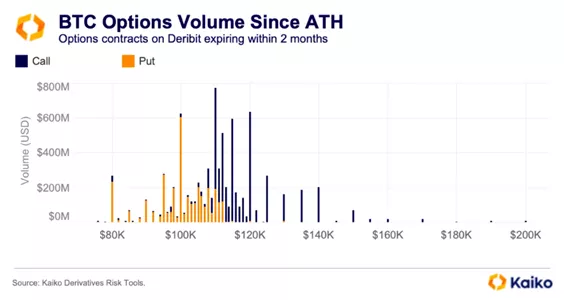
Bitcoin could climb to $125,000 in June if a soft U.S. jobs report fuels expectations of early Fed rate cuts, according to analysts, though stronger labor data might drag prices toward $95,000.
“We believe if bitcoin maintains support above $105,000, it could target the $120,000–$125,000 range in June,” the analysts said. “This will not be catalysed just from the labor market, but it could be a domino in multiple catalysts prompting the Fed to cut rates at a faster than expected pace.”
“On the downside, we see a 95-97K region for any local bottom and see some good accumulation there,” they said.
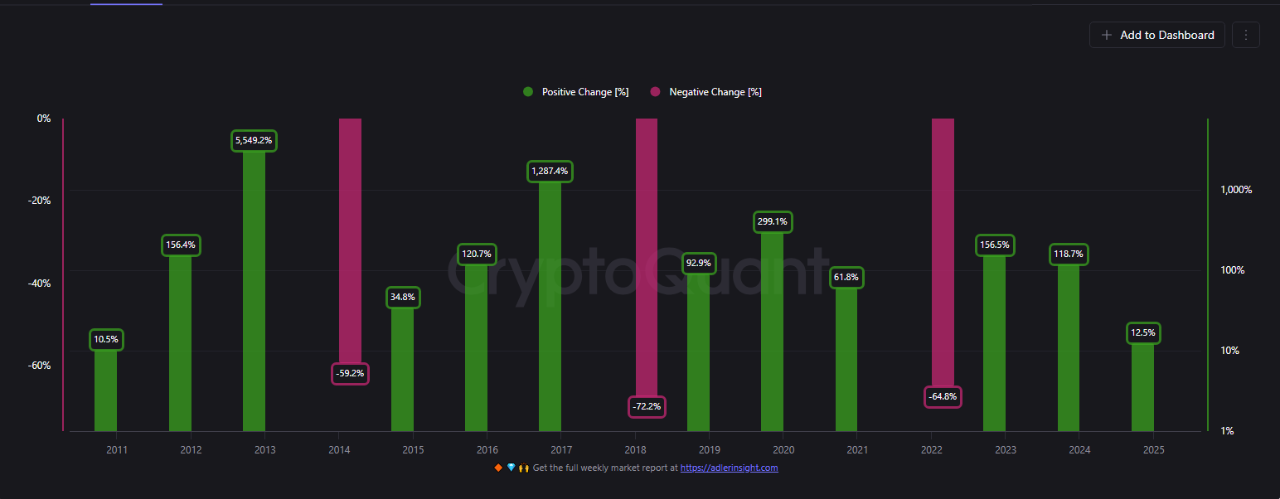
Carmelo Alemán, Verified On-Chain Analyst at Cryptoquant reveals The Bitcoin Yearly Percentage Trend. He speaks about a recurring cycle of three years of growth followed by one of consolidation, matching Bitcoin’s four-year halving rhythm.
The importance of this growth cycle is that, based on this metric, if Bitcoin maintains the pace typical of the third year in the cycle, it could grow about 120% during 2025. Starting from $93,226, this would take the price to $205,097, potentially marking the cycle top for this year. If this logic holds, it’s likely that 2025 will close as the third consecutive bullish year, thus completing another positive cycle.
A comparison of the charts of the second largest cryptocurrency and gold showed thatEthereum repeats the structure of precious metal accumulationfrom 2019 to 2024.

Gold completed the pattern with a break above $2,100 in early 2024, showing growth of more than 60% to records above $3,400. Ethereum may now follow a similar trajectory, bouncing off the low of point 4 near $1,600 and approaching the resistance zone of $ 3,000-3,500 — a similar breakout point for gold.
A similarities between the current situation of Ethereum and that observed in 2016-2017 promises a price increase to $ 5000-6000.

CONCLUSION:
Indeed, this month the market society is more busy with geopolitical challenges, tariffs and other stuff. And a lot of room is given to crypto markets and pure economy factors. Still, there are two moments for discussion.
Let’s start with overall market expectations. I would call them as moderately positive, and in general people tell the same as we do in our regular technical updates on BTC. Targets are different but majority of them stand in $115-120K area. Our long-term upside target is $127K, which is very close. Crucial levels for short-term bullish scenario are correctly mentioned around 96-97K – we just talked about it in recent video. So, here we have objections.
THe most interesting stuff is a Genius Bill. It has a few minor caveats but also has a big major caveat. Among minor caveats we could mention big hole for manipulations.
“In advancing these bills, lawmakers forfeited their opportunity to confront Trump’s crypto grift – the largest, most flagrant corruption in presidential history,” said Bartlett Naylor, financial policy advocate for Public Citizen, a consumer rights advocacy group.
Other Democrats expressed concern that the bill would not prevent big tech companies from issuing their own private stablecoins, and argued that legislation needed stronger anti-money laundering protections and prohibitions on foreign stablecoin issuers.
“A bill that turbocharges the stablecoin market, while facilitating the president’s corruption and undermining national security, financial stability, and consumer protection is worse than no bill at all,” said Senator Elizabeth Warren, a Democrat, in remarks on the Senate floor in May.
In fact, Act prohibits members of Congress and their families from making money on stablecoins, but this restriction does not apply to the president and his family. This has caused discontent among some Democrats because Donald Trump and his family have their own crypto projects.
“CSBS remains concerned with the dramatic and unsupported expansion of the authority of uninsured banks to conduct money transmission or custody activities nationwide without the approval or oversight of host state supervisors,” said Brandon Milhorn, president and CEO of the Conference of State Bank Supervisors, in a statement.
If the law is passed, experts predict rapid growth of the stablecoin market – from the current $250 billion to more than $2 trillion by 2028

So let’s keep for old Donnie his favorite toy – ability move markets by his twits full pockets with cash.
Major caveat from this Act is quite different. The law passed by the US Congress is formalized the link between crypto bubbles and the banking sector. Circle made an IPO two weeks ago and is up about 700% in that time. The company is now worth more than half of the other issuers in the S&P 500.
The recognition of the legal status of “stablecoins”, which are an intermediate type of cryptocurrency for exchanging cash between highly speculative coins and the traditional banking system, is the end of the cycle.
Do you think that law makers carry about stablecoins or crypto industry, traders? Absolutely not. By our opinion this act is nothing else but an attempt to find replacement for US Treasuries weaker demand.
Previously bonds and bills mostly were a subject of banks, large brokers, hedge funds and other Wall Street society, foreign investors. But demand is falling, while government needs more money and issues more and more debt. How to find a demand for it? Make process simpler. Now any company that intends to issue own stablecoin will have to back it with short-term US debt.
Second – at the same time they keep stablecoins aside from the major feature of the debt, which is accrued interest. According to Act, stablecoins can’t be used for accumulating interest. So it can’t work as a tool for savings. So, they can’t replace national currency. It could be used only as a transaction tool.
Some analysts tell that this is ability to issue own corporate currency for any company. And they see that US government failed to fulfil its own promise to not let this ever to happen. But they are wrong. Lack of accumulated interest and obligation of using of the US debt collateral makes stablecoins a proxy of US dollar. In fact, this is just a wrap – say, Walmart stablecoin or Amazon stablecoin. Because they bought US bills, issued by US Treasury, so anyway, the core of any stablecoin is a US Debt that belongs to US government. Any stablecoin could be destroyed in a blink of an eye if SEC forbids to use bills to particular company.
In fact, we see here hybrid QE mechanism and the way how to park another 2 Trln of US debt so, that it would look like this is not a QE or money printing.
Whether it will have a upside effect on BTC? Hardly, because it has to have raising effect on US debt demand. Otherwise, they would force to use BTC as a collateral. Besides, a number of stablecoins will start raising as mushrooms after the rain and it could take the shape of NFT, where every company will start to issue it. The only feature of stablecoins for people will be transactions.
IT is also clear what benefit will companies get. Making their own stablecoin could let holding of clients cash on their account and totally control all transactions inside the companies processing center. Say, you are regulary buying something from Amazon and you keep their stablecoins on your account inside the company. At the same time they could earn interest on collateral that in fact your money and you dont’ get it.
That’s being said, despite big hype around this Genius act, we suggest that US government is a major beneficiary, and we do not see any relationship with bitcoin price, if even the amount of stable coins will raise ten times. In this case BTC could rise mostly due US Dollar devaluation but not because of stablecoins amount.
Author Profile

Sive Morten
By day Sive Morten works for the large European bank. In that roll he evaluates the markets including currencies market managing bank risks and evaluating the bank portfolio.
At the Forex Peace Army, he is known as an author of Forex Military School, which quite unique free forex trading course. We do not know of any other free forex trading education covering such a broad spectrum of forex market concepts in such details while keeping it easy to understand and practically use.
As if that wasn't enough, he is the part of the Shoulders of Giants Program. He shares with his fellow traders at FPA his view and forcast of the Gold Market, Currency Market, and Crypto Market in form of weekly analytics and daily video updates.
* Complete Forex Trading Course by Sive Morten >>
* Sive Morten Forex , Gold , and Crypto Analysis >>
At the Forex Peace Army, he is known as an author of Forex Military School, which quite unique free forex trading course. We do not know of any other free forex trading education covering such a broad spectrum of forex market concepts in such details while keeping it easy to understand and practically use.
As if that wasn't enough, he is the part of the Shoulders of Giants Program. He shares with his fellow traders at FPA his view and forcast of the Gold Market, Currency Market, and Crypto Market in form of weekly analytics and daily video updates.
* Complete Forex Trading Course by Sive Morten >>
* Sive Morten Forex , Gold , and Crypto Analysis >>
Info
164 Views 0 CommentsComments
Table of Contents
Recent
ePlanet Brokers Expands Transparency Efforts With New H1 2026 Operational Disclosures PrimeXBT Rewards Center Explained: How to Earn Cashback, Trading Bonuses and VIP Benefits Bitcoin Fundamental Briefing, August 2026 How to start forex trading How to choose the best forex broker? XAUUSD vs EURUSD: What Actually Changes When You Trade Gold Can You Buy Real US Shares With USDT? Ownership, Dividends and Shareholder Rights Explained Bitcoin Fundamental Briefing, July 2026
Popular
The Psychology of Forex Trading Forex Trading in the United States How to Combine Different Types of Forex Analysis Forex Peace Army | Forex Reviews by Traders | Evolution and Future Forex Peace Army Executive Team Forex Sentiment Analysis How to add or remove horizontal and vertical lines in MetaTarder 4 How to select a forex broker